

When social media first emerged, we were optimistic. It was rethinking communication. It was open, democratic, and censorship-free. It was the ideal marketplace of ideas.
Perspectives have changed over the last decade.


>monkey paw curls
And yet, we keep posting.
The ever-present pull of open, global discussion isn't going away.
And, while I'm not going to sit here and try to convince you that social media has no negative effects, from a white-pill perspective, I think there's more positive energy out there than we've convinced ourselves of late.
Most of us can sense it, despite persistent doomerism from our peers.

the universe is always listening. you never know who’s reading, who’s watching, who’s ready to help it unfold
twitter is a magical place


We have evidence to back up this optimistic perspective on the modern internet. Consider the most-liked social media posts of all time.
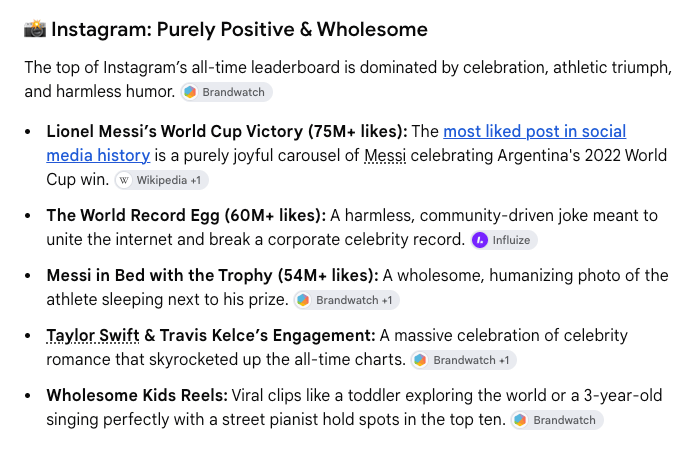
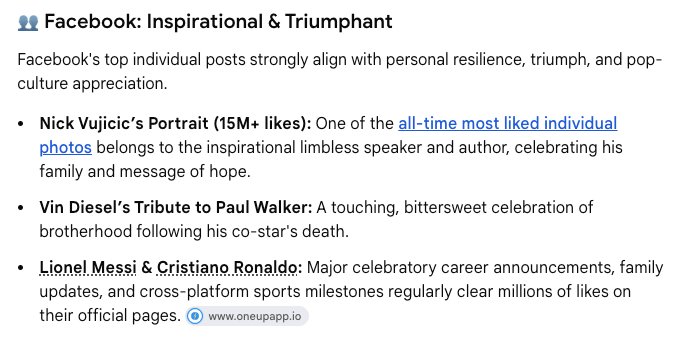
Is the debate more complex than this evidence? Sure, but we don't need to litigate it all here.
For now, I think it's at least safe to say there's a compelling case that wholesome energy > negative energy online.
But if there's clearly a great deal of positivity online, why is the modern narrative focused on negative real-world impacts?
It's a problem of social physics and economics.
It's both cheaper and less socially complex for negative energy online to translate to negative outcomes IRL.
And, on the flip side, it's expensive and socially complex for positive energy online to translate to positive outcomes IRL.
It takes an online community of people time, mental energy, and financial coordination to accomplish significant achievements IRL. It only takes one chaotic person to tear it all down.
This leaves us with a world where we can see the potential for a better world hypothesized online, but the ability to manifest the outcomes we care about feels out of reach.
How do we balance this equation?
Let's consider social media's potential for positivity and how two tools, one currently hyped, one currently disregarded, can unlock its potential.
The early 2010s promise of social media is easy to forget. There was no shortage of inspirational takes about instant, global communication improving society.
It was the era of Occupy Wall Street and the Arab Spring. The "text-messaging generation" was bringing down presidents. Ron Paul was campaigning for president with a grassroots, online-focused campaign.
We had the internet, we could connect seamlessly with our friends, and we were going to change the world.
But that idealism ran into the friction of translating online energy to IRL action. Disconnects emerged between the ability to hype outcomes on social media and the ability to make them happen.
Twitter, Facebook, Reddit, Instagram, etc. became excellent at measuring attention and how much the hivemind cared about things in the moment. Where they failed was when it came time to translate that attention into action.
We had more information than we were capable of dealing with.


Black pill? Khitty is right, social media has cooked society, and we might as well give up.
White pill? It's not information overload. It's filter failure.
And, thankfully, we've invented the intelligence machine.

Expect a divergence:
* Those who wield AI agents to shield them from noise.
* Those who are slaves to someone else's algorithm.
If we think about the formula for coordinating positive-sum behavior amongst humans, two of the most important inputs are:
information
intelligence
You need information to make a decision, but that decision needs to be guided by an understanding of its surrounding context.
And the AI tools that have emerged in the last 5 years are perfect for doing just that.
All the information was out there for years on the internet regarding how to build a website. But your parents couldn't do it.
Now? They can use a free subscription and a prompt to generate a website in a few minutes.
Your coworker just made a custom app that saves everyone hours of work each week. Your fantasy football leaguemate is coding their own player analysis tools. Your kid is building a Pokémon card classification tool with built-in computer vision.
It's faster and easier than ever to research, code, design, analyze, monitor, plan, or iterate. It's the most interesting time in human history to be a builder.
Clear skies ahead for societal coordination and efficiency then, yes?
Not quite. AI runs into an execution problem when it hits the offline world.

"I thought when we got to GPT-4, which was back in 2023, that very quickly after that there was going to be much more disruption, software businesses up for grabs right away,

"We were way behind Claude Code, and it seemed like a kind of crazy kamikaze mission to try to beat them with a coding app."
"The

This is explained further by Tyler Cowen's commentary on the slow take-off of AI adoption (credit to @orphcorp for pointing this out).
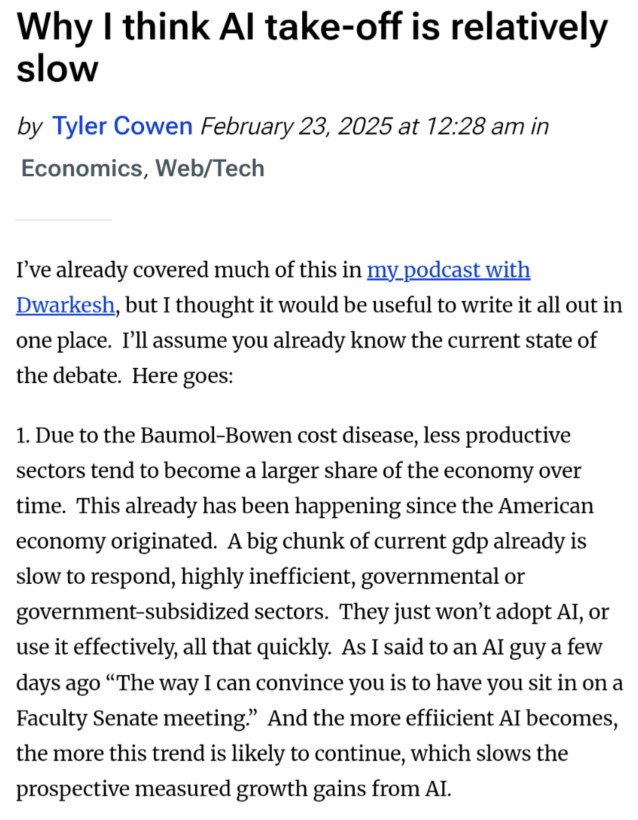
TL;DR the sectors of the economy that matter most to people, their businesses, local communities, and national communities are all controlled by legacy organizations that weren't built to move at the speed of AI.
People who live online 24/7 are blown away by what AI can do because it interacts directly with the world they care about.
People who mainly work and live offline? They're wondering what the fuss is about because the tech gets throttled before it reaches them.
So here we sit.
We have instant communication channels with our peers around the world and machines that give us unlimited intelligence at our fingertips.
But we're still stuck when it comes to moving the world around us because the traditional organizational structures humans have used for thousands of years to coordinate real-world actions aren't made for unlimited intelligence and frictionless communication.
How can we make IRL more reflexive to this new paradigm?
Money.
"The main reason why it is profitable to establish a firm would seem to be that there is a cost of using the price mechanism. The most obvious cost of 'organising' production through the price mechanism is that of discovering what the relevant prices are... The costs of negotiating and concluding a separate contract for each exchange transaction which takes place on a market must also be taken into account... a firm will tend to expand until the costs of organising an extra transaction within the firm become equal to the costs of carrying out the same transaction by means of an exchange on the open market or the costs of organising in another firm."
Coordination is expensive.
That was the big takeaway from Ronald Coase's landmark 1937 paper, The Nature of the Firm.
Specifically, it's expensive because finding prices is hard. We think of prices as something that the market produces automatically, but in reality it takes many individuals with access to good information communicating with each other to produce them.
Sounds like a job for AI, right? Economists agree. They've started hypothesizing that we're on our way to a "Coasean Singularity".

I just fell down a rabbit hole reading a new paper from economists at MIT & Harvard.
Their prediction is wild: We're on the verge of a "Coasean Singularity"—a future where AI agents make markets so efficient that the very idea of a 'company' starts to crumble.

A thread

But we've already covered a bit of the problem this thesis runs into. Most of the economy is still run by legacy organizations that are slow to adopt AI.
And individuals? They've proven far less open to letting AI agents manage their money than many researchers originally hypothesized.
Nonetheless, the idea seems obvious. If all the costs of driving coordinated economic activity are starting to collapse, what new types of behaviors will pop up that were originally limited by the need to form organizations?
The internet has attacked the cost of information.
AI has attacked the cost of intelligence in processing that information.
But we still need a solution that attacks the friction of coordinating with money.
And that's where crypto comes in.
We create organizations because we want specific outcomes.
Remember what Coase said:
The most obvious cost of 'organising' production through the price mechanism is that of discovering what the relevant prices are.
The point of organization is to produce something specific. An outcome.
There's no shortage of hypothetical outcomes being proposed on the internet every day. Social media is awash in them. But generally, they are missing price information.

"someone should..."
"I wish someone would..."
"why doesn't anyone..."
"it would be cool if..."
is essentially unpriced collective demand (beyond the social signals of likes/reposts/etc)
figuring out how to price it would be huge
social media needs a tool that translates its energy into outcomes
What keeps us from putting prices on them?
Our preconceived notions about the costs of organization.
Nobody wants to be the person who arranges money to get something done. Even if you've never read Coase's arguments about the science of the firm, you know from human experience. Managing people's money and expectations is a headache.
But what if there was a cleaner solution:
you propose the exact outcome you want to see happen
anyone can add money if they also want to see that specific outcome happen (but, importantly, you don't have to manage their money)
if the outcome happens, the money gets paid out to whoever made it happen
if the outcome doesn't happen, everyone gets their money back without lifting a finger
With fiat, this gets messy fast. One person would need to hold everyone's money (and likely do so via a centralized bank or payment provider who acts as custodian). They'd need to take on legal risk in doing so. They'd then need to physically track down whoever in the world wants to complete the outcome. They'd then need to track the work and relay everything to the funders.
It's a hassle.
But with crypto and smart contracts? It just works. And it's what we've built with poidh.

What problems would you put up a bounty to solve?
I have a few ideas in mind for the next one, just need more people to back the
currently reviewing the submissions on this bounty so far, aiming to have shareable public results later tonight
local AI is cool


Build a CELL hardware wallet from scratch and sign with it
CELL is a new hardware wallet concept designed to be simple enough to build at home with minimal equipment and a raspberry pi. It is "human-first", in terms of checking the owner's pulse for ordina...


Now, poidh is still small. The contracts have only processed ~$90k in bounty volume all-time. Getting people to wrap their head around a permissionless way to price outcomes while convincing them that they can trust it with their money is hard.
It also takes a shift in the way we've been trained to think. For hundreds of years, people have assumed that if you want to get a big goal done, you need an organization. Getting them to adopt a mindset of "you can just incentivize things" is an uphill battle.
And hey, maybe we have the wrong recipe as well. We could be close to the solution but not quite there.
Nonetheless, I feel confident stating that, if we are going to discover a breakthrough application of crypto tech that changes the way humans live, work, and collaborate together, it will be in this vein.
Almost 100 years ago, Coase made it clear that economic activity involving organizations was driven by the costs associated with coordination.
information/search costs
intelligence/execution costs
settlement/escrow costs
We now have the technology to attack all 3.
internet ↓ information/search costs
AI ↓ intelligence/execution costs
crypto ↓ settlement/escrow costs
Let's dream big about what that can accomplish.
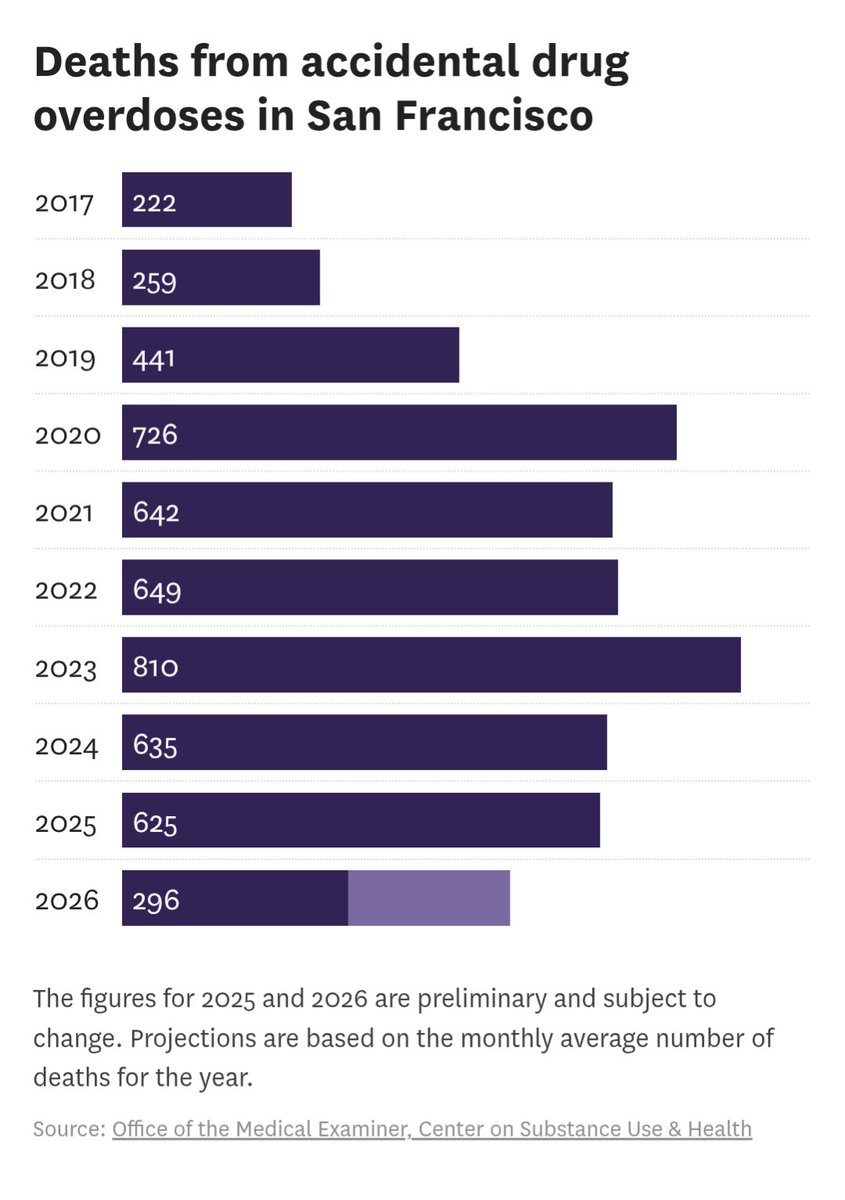
anyone could add money to the bounty, and the city could only claim it after hitting the target
what would be the free market price of that outcome?
If your interest is piqued regarding poidh as a coordination protocol, I recommend checking out our previous blog in this series.
Looking to explore how it all works from the ground up? Check out docs.poidh.xyz.
Want to start making bounties, helping to fund them, or earning by accomplishing outcomes? Get started now via poidh.xyz.
We are currently fundraising so I can go full-time, hire a dev team, and scale the protocol. If you're interested, my DMs are open, or you can reach me on TG via the same handle (@ kennyistyping).
Crypto is coordination tech. If you want to help it fulfill its potential, let's talk.